


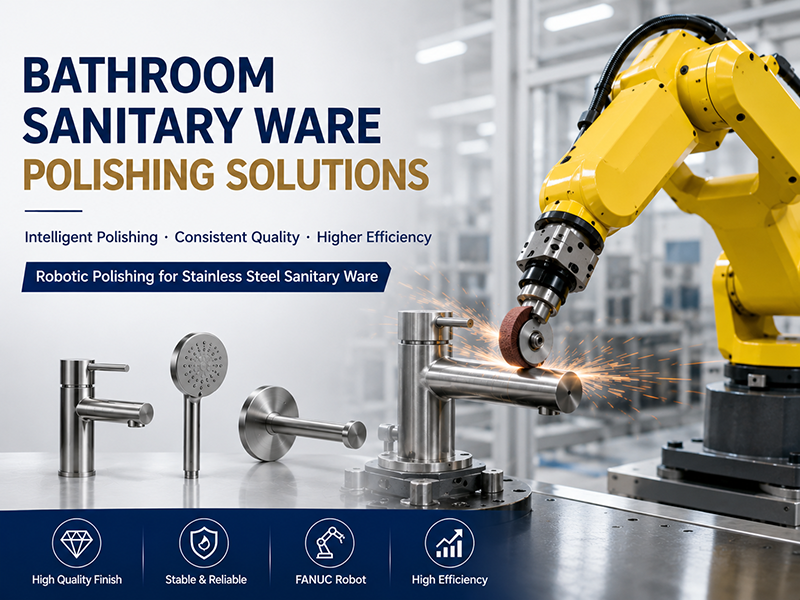

Automated Polishing VS Manual Polishing
Polishing is a critical process in metal surface finishing, directly affecting product appearance, quality, and performance. Traditionally, polishing has been performed manually, but with the rise of automation, robotic polishing systems are becoming the preferred choice for manufacturers.
- What Is Manual Polishing?
Manual polishing relies on skilled workers to operate polishing tools and machines to finish metal surfaces.
Advantages:
- Flexible for complex shapes
- Lower initial investment
- Easy to start production
Disadvantages
- Inconsistent quality
- High labor cost
- Low efficiency
- Worker fatigue affects results
- What Is Automated Polishing?
Automated polishing uses robots, CNC systems, and intelligent controls to perform polishing tasks with high precision and consistency.
Advantages:
- High consistency
- 24/7 operation
- Reduced labor dependency
- Better surface quality
Disadvantages
- Higher initial investment
- Requires programming
- Key Differences Between Automated and Manual Polishing
| Aspect | Automated Polishing | Manual Polishing |
| Efficiency | Very high | Low to medium |
| Consistency | Excellent | Varies |
| Labor cost | Low | High |
| Surface quality | Stable and uniform | Depends on skill |
| Scalability | Easy for mass production | Difficult |
- Why Manufacturers Are Moving to Automation
Modern manufacturers are rapidly adopting automated polishing systems due to several key factors:
- Cost Reduction
Automation reduces long-term labor costs and increases ROI.
- Quality Stability
Robots eliminate human error and ensure consistent results.
- Higher Productivity
Continuous operation significantly boosts production output.
- Smart Manufacturing Upgrade
Automation is a key step toward Industry 4.0.
- Application Scenarios
Automated polishing systems are widely used in:
- Sanitary ware (faucets, bathroom accessories)
- Automotive parts
- Metal castings
- Hardware and tools
For high-volume and high-precision industries, automated polishing is the better choice.
- Conclusion
While manual polishing still has its place in certain applications, automated polishing is becoming the dominant solution in modern manufacturing.
With higher efficiency, better consistency, and lower long-term costs, automated polishing systems are the future of metal surface finishing.